
BMI: Still Relevant
The study I reviewed on Tuesday was trying to establish that body fat as assessed by BIA was a better predictor of the 25-year death rate than BMI. Researchers made their case by using data collected in the 1999–2000 NHANES wave to establish that a measure of body fat that can be collected with a device such asse a scale or wrist monitor was better than hard data like height and weight as used in calculating BMI.
BIA and Body Fat
I have a unique perspective on BIA because I was part of a laboratory that collected validation data on the original devices. The researchers continuously stated that BIA was a direct measurement of body fat, but that’s not correct. BIA measures the body’s resistance to a low electrical current through the body; then that number is put into an equation combined with other measures—primarily height and weight—to calculate a percentage of body fat. In that wave of the NHANES study, they also collected waist circumference and skin-fold measures to obtain the best predictive equation for use in future studies.
I’m certain that the equations have been updated over the years, but at that time, the model for calculation of body fat was 95% dependent on height and weight. Recent standard errors of the measurement of BIA for body fat range from 3.6% to 6%. There are many reasons for errors of that size, but impedance is particularly sensitive to changes in hydration and alcohol consumption. And to be clear, BIA is not a direct measurement of body fat—it’s just simple to use.
BMI Is Still Relevant
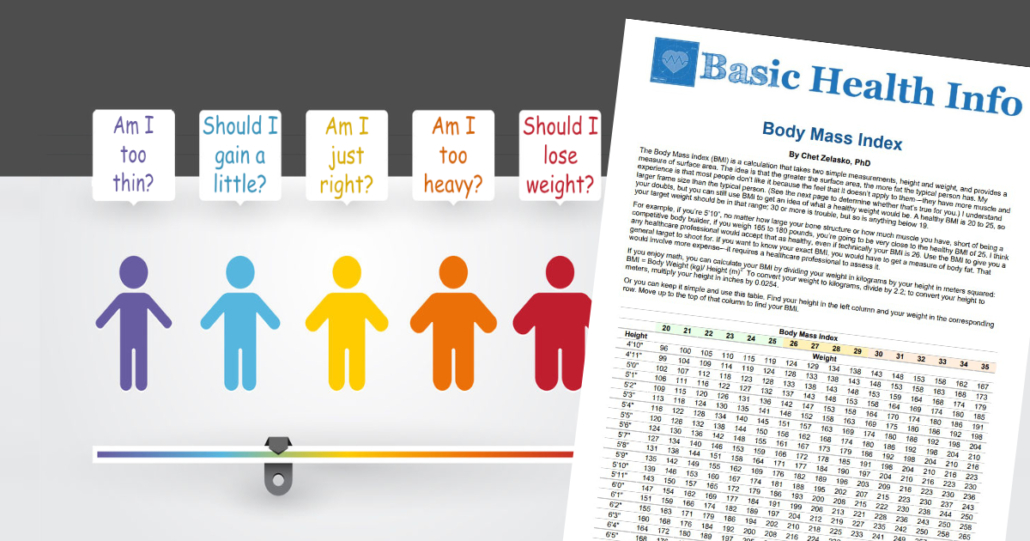
BMI is measure of surface area. It would be nice if more surface area indicated increased muscularity, but for 99.5% of us it’s not. It’s an indication, not a direct measurement, of our body fatness. It does tell us whether we are at a normal weight for our height.
BMI should not be used with hard edges. I would be hard pressed to say that there is a significant risk of anything for someone who has a BMI of 25.9 versus a BMI of 24.9; the former indicates overweight while the latter indicates normal weight. That’s a difference of just six pounds, and a good bowel movement could account for half of that. It’s not relevant in the real world. But a BMI of over 30 indicates that someone is obese, and that affects an increasing number of people in the U.S. and other industrialized nations.
The Bottom Line
BMI is still the best metric we have for assessing whether someone is at a healthy weight for their height. We can try to account for bone size and muscularity, but that doesn’t apply to most people. Getting to a healthy weight and staying there is still the best way to live the longest and the healthiest life. There’s no splitting hairs over that.
Here’s a factoid for you: our email platform tells us how many clicks we get on whatever we send you, and by far the most-clicked page is the BMI chart in the Health Info section. And we include adjustments for frame size, so you’ll know for sure if you’re really big boned. We hope having that info easily available helps you make good decisions about your health, because a BMI chart is still the easiest way to determine whether your weight needs to come down.
What are you prepared to do today?
Dr. Chet
Reference: Ann Fam Med 2025;23:Online. https://doi.org/10.1370/afm.240330