Again with the BMI?
I got an email from a long-time reader about a recently published study comparing BMI calculated from height and weight with percent body fat calculated via Dual Energy X-Ray Absorptiometry commonly called DEXA. The objective of the study was to see if BMI was accurate in predicting the differences between underweight, normal weight, and several degrees of overweight and obesity with measure of body fatness.
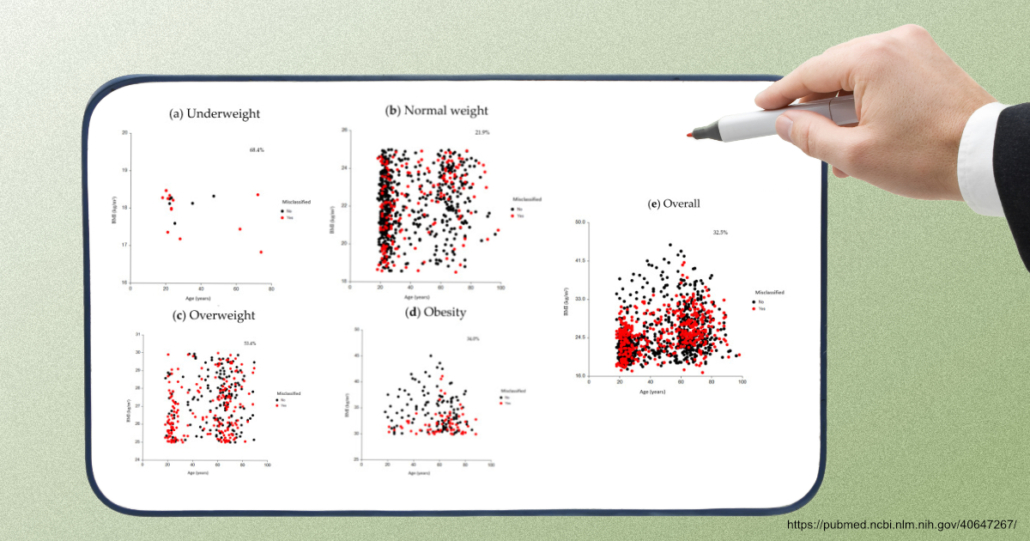
Their subject pool was 1,351 Caucasian men and women 18–98 years old. This was a cross-sectional study (and more than likely a retrospective study) of patients in Italy who had their body fat assessed via DEXA between 2013 and 2024. While this paper contained hundreds of numbers, the essence of what they found was that for those with normal-weight BMI, body fatness was accurate, but for underweight and overweight and obese subjects, BMI under or overestimated their actual body fat; in the chart above, a red dot indicates someone whose BMI was misclassified. The authors felt that the World Health Organization should consider more research because the misclassification may impact diagnostic capability and thus lead to unnecessary treatment protocols.
Why BMI Should Still Be Used
I think the researchers are wrong in their conclusion for the following reasons:
- While there were definite points where people were misclassified based on the graphic presentation of all data points, it was mostly on the margins. Is there a difference between a BMI of 24.5 versus 25.5? Is there a real difference in a person who has a BMI of 33.0 versus 36.0? Because of the way the data were analyzed by weight classification, the measure loses the nuance.
- Regardless of the numbers, a physical examination by the healthcare professional should confirm whether a person is normal weight or overweight based on the fluffiness factor. People of the same height and weight may look muscular or like the doughboy of commercials.
The Bottom Line
The question of using BMI as a measure of body fatness in large groups will probably never be over. But when assessing large groups of people, it’s still the best measure for an overview of whether a population is underweight, normal weight, or overweight. If people really need to know more, they can always pay to have a DEXA scan done.
On a personal level, will it really give you any more information than when you stand naked in front of a mirror? When you know, you know. The important question is what are you going to do about it?
What are you prepared to do today?
Dr. Chet
Reference: Nutrients. 2025. https://doi.org/10.3390/ nu17132162