Folic Acid, Lead, and Autism

Every once in a while, a research study provides an important lesson as well as some interesting findings. Let’s begin with the study.

During 2008 through 2011, researchers selected almost 1,900 pregnant women as subjects from 10 cities across Canada for the study. The overall goal was to identify environmental impacts on the mothers and children; this is an ongoing study. In this case, researchers looked at children who were diagnosed with autism, based on standard diagnostic criteria. Understand that autism is on a spectrum, and they used behaviors associated with autism when the children were three or four years old. They also tested maternal lead levels, folate levels, and folic acid intake in early pregnancy.

Researchers found there was an inverse relationship between blood lead levels and folic acid intake—as folic acid intake increased, the blood levels of lead decreased. The autism scores were also lower in the children of mothers who had sufficient folic acid intake, verified by their blood folate levels; 400 mcg intake was sufficient, and taking more folic acid didn’t provide additional benefit.

What does it mean? No one has to megadose folic acid to benefit their unborn children in response to environmental toxins. And even if pregnancy isn’t part of your future, the folic acid had a protective effect; if you suspect you have lead pipes, additional folic acid is a good idea.

What was the lesson? I’ll let you know on Saturday.

What are you prepared to do today?

        Dr. Chet

Reference: https://doi.org/10.1289/EHP14479

Do Weekend Warriors Improve Their Health?

Let’s finish the week with a question no one asked but was the topic of a recent study: what’s better for your health—being a weekend warrior or working out according to established guidelines? The major component of the guidelines is more than 150 minutes of moderate to intense exercise a week spread out over most days of the week. Turns out, they are both effective, but let’s take a closer look.

The Study

The UK Biobank data are connected to the medical records of all people in the UK, making it an excellent source for studies. This observational study used data collected on close to 90,000 subjects who wore an accelerometer for a week sometime between 2013 and 2015; they were tracked for at least six years. Researchers tracked the diagnosis of over 678 conditions and compared those who exceeded the minimum of 150 minutes of moderate to intense exercise, either over a weekend or stretched over a week, with those who exercised fewer minutes.

The weekend warriors had reduced Hazard Ratios for 264 conditions and regular weekday activity had reduced Hazard Ratios for 205. Most of the benefits were associated with cardiometabolic metrics such as hypertension, resting heart rate, and type 2 diabetes. When compared head-to-head, there were no conditions where the weekend warriors and the regular exercisers differed.

What Should I Do?

I wouldn’t change anything you’re currently doing as long as you’re getting more than 150 minutes of moderate to intense exercise every week. We don’t know the activities involved in either—just that the accelerometer showed they were moving.

What it can mean is that for those who are playing basketball or soccer for a couple of hours a day on the weekends, you’re getting some benefit. It also means if you have a two-hour trail walk you like to do on weekends, it can help reduce your risk of cardiometabolic diseases.

The Bottom Line

What I really think it illustrates is that any movement is good movement, and if you can’t work in as much exercise as you’d like during the week, you can make up for it on the weekend. I would have liked to have seen the different activities involved and any orthopedic injuries associated with the activities, but let’s take the win. Just get moving and stay moving during the week or packed into a weekend. Or—maybe—both! Go get ’em, you warriors!

What are you prepared to do today?

        Dr. Chet

Reference: https://doi.org/10.1161/CIRCULATIONAHA.124.068669

What About Fiber?

Here’s one more thing you might want to add to your smoothie: fiber. In this case, it depends on the type of fiber more than anything else. Let me illustrate. My grandson Riley and I have something we call “soup” almost every night. It has two kinds of fiber as well as a probiotic mixed with water.

Riley can be pokey when he eats and sometimes, it carries over to when he drinks liquids. One evening, when I wasn’t paying attention, he didn’t drink his soup quickly enough, and it turned into a jelly-like consistency. The reason is that one of the fibers I put in the blend is ground psyllium husks, and while it’s great fiber, that’s one of its characteristics. It will do the same thing if you take too long to drink your smoothie.

There are some fibers that don’t turn to gel quite as fast as psyllium husks such as inulin, pectin, guar gum, and digestion-resistant maltodextrin. These fibers function differently than psyllium fiber. I don’t know that I would prepare them the night before and let them sit in the fridge overnight, but hey, if you’re willing to give it a try, go for it.

The Insider Conference Call is tomorrow night. The topic of the night is a look at the benefits of blood orange on metabolism as well as answering Insider questions. You can join in by becoming an Insider by 8 p.m. Wednesday evening.

What are you prepared to do today?

        Dr. Chet

Should You Put Probiotics in Your Smoothie?

Continuing with smoothies and shakes, another popular ingredient most people want to add are probiotics, either from yogurt or a supplement. Would there be any issue with adding probiotics to smoothies? No, as far as I could find. It’s the same idea as with the digestive enzymes: the probiotic will start to do its job, which is to ferment once it’s fed. Starches, prebiotics like inulin and dextrin, and fructooligosaccharides (FOS) are the preferential foods for the microbes.

Adding fruit or vegetables to the smoothie would be adding some FOS as well as some naturally occurring fibers. Again, just like the digestive enzymes, the shake would have to be left out a long time for any reasonable fermentation to occur. One more thing: while the probiotics would have fluids and food, the one thing they would not have in a smoothie is heat. Probiotics are not likely to start fermentation when they’re closer to refrigerator temperature than internal body temperature.

And one more thing. Would putting the probiotics in a blender at high speed damage the bacteria? The answer appears to be no based on comments from scientists who do research on bacteria. Imagine slicing a mosquito with a chainsaw; the blender’s blades aren’t small enough to slice and dice the bacteria, and the heat the blades generate isn’t enough to damage a significant amount of probiotics.

The one thing that will destroy probiotics is heat over 165 degrees, so don’t put them in soup or hot drinks. More to come.

What are you prepared to do today?

        Dr. Chet

What Do You Want to Know?

I’m back from a weekend in Louisville where I talked to many, many people about their nutrition questions. One of the great advantages of these trips is that I know which nutrition questions are most important to people right now. So let’s talk about shakes.

I prefer chewing my food. I’ve tried shakes and smoothies, and they just don’t do it for me, but it’s become a convenient and nutritious way of life for many of you. I’ve gotten a number of questions on what you should and maybe shouldn’t put into smoothies, so let’s cover several of them as well as other questions in the next few memos.

Let’s begin with digestive enzymes. The typical digestive enzyme supplement has several different enzymes to digest food. There are proteases to digest protein, lipases to digest fats, several enzymes that can break down different classes of carbohydrates, and many also have lactases to digest lactase, the milk sugar.

What would putting digestive enzymes in smoothies do? Some enzymes require stomach acids to activate. More than likely, other enzymes would start to breakdown the nutrients they’re designed to digest. Is that a bad thing? Not necessarily, unless you leave the smoothie to sit for hours—which is exactly what you probably wanted to avoid. It may change the flavor if it sits too long but otherwise, it should be fine.

More on Saturday. And if you have any questions about nutrition or supplements, let me know and if I think it applies to lots of other people, your question could star in an upcoming Memo!

What are you prepared to do today?

        Dr. Chet

Are Heart Meds Forever?

The prevailing thought on pharmacological treatment of cardiovascular disease (CVD) is that once you’re on a class of medications, you’re on them for life—new meds may be developed to replace some, but treatment continues forever. That contributes to the conspiracies about big pharma and the greed of the medical community. I’m not going to say that never happens, but maybe a recent study can reveal a ray of hope.

Beta-Blocker Study

Researchers selected a very specific group of potential subjects from three countries. The subjects must have had a myocardial infarction (MI), also known as a heart attack; they must have had both angiography and an echocardiogram; they must have an ejection fraction equal to 50% or more; and they were tracked for 3.5 years.

This is the important part: On a randomized basis, half were given the typical treatment of beta-blockers while the other half were not. There were two intermediate analyses of the data to make sure the non-beta blocker group were not at greater risk for problems such as another MI, or worse yet, death.

The analyses demonstrated that there were no differences in outcomes related to any CVD condition between the groups. In other words, the beta-blocker did not provide any additional benefit. There are more trials underway to confirm these results, but we now have a first step on the path to determining whether medications are necessary for life or not.

The Bottom Line

Let me be clear: Do not stop any medication without discussing it with your physician! All physicians were aware that their patients were in the trial and who was and was not on beta-blockers. Also, the standard for ejection fractions (amount of blood pumped per beat) was relatively high. But it illustrates this point: Every visit to your physician or specialist should include a thorough discussion of your medications and whether you need to remain on each one.

There’s also another part to all this: What are you willing to do to help eliminate the need for the medication? Diet, exercise, reducing body weight? What will you do if it will help? In other words:

What are you prepared to do today?

        Dr. Chet

Reference:  N Engl J Med 2024;390:1372-81

A Little Good News

On January 2, 2023, the Buffalo Bills were playing the Cincinnati Bengals on Monday night football. A Bengal caught a pass, was tackled and fell into one of the Bills, Damar Hamlin, hitting him in the chest as he fell. Both players got up, and then Hamlin fell down again. What we didn’t know for a while was that he had a cardiac arrest and was clinically dead. Through the efforts of the training staff, they got his heart started and they headed to the hospital. He recovered, but the story didn’t stop there.

Hamlin began a mission to work with the American Heart Association to educate the nation about how to do CPR. If you don’t remember, check out this Memo. There’s no question that because of his misfortune, hundreds of thousands of people know how to save someone’s life with CPR.

Hamlin has come full circle as well. He was cleared to play football and began the long trip back. The good news is that he’s not only back but he’s a starter for the Bills this season; he got his first interception ever in a game a week or so ago. Just a little good news to begin the month.

What are you prepared to do today?

        Dr. Chet

Reference: https://www.heart.org/en/damar-hamlins-3-for-heart-cpr-challenge

The FFQ: Still Too Vague

I spent a long time examining validation and reliability studies on the Food Frequency Questionnaires (FFQ). It was interesting to compare the original validation studies with a new FFQ that was published in early 2024; researchers asked subjects in those studies that began decades ago to participate in this recent validation study.

The Stats

I learned more about a variety of statistics that I don’t typically encounter: coefficient of correlation, and then attenuated and deattenuated coefficient of correlations, and more. The researchers concluded that the “study showed that the FFQ used in prior studies has reasonably high reproducibility and validity in measuring food and food groups intakes among both women and men.” I disagree.

The coefficient of correlation is important (COC) because it gives an indication of the association of the variable with a standard, in this case a 7 Day Dietary Recall. The best COC is 1.0 or -1.0, which means it’s perfectly correlated or not correlated with the standard. A COC greater than 0.8 is considered a strong relationship, but a relationship of 0.6 – 0.79 is considered moderate.

The COC for most categories of food was well below 0.6. How can that in any way be valid? It may be reproduceable, but you’re reproducing the same mistake over and over again.

How Dangerous Is Meat?

High level analytics like this aren’t my area of expertise, but logic dictates that you can’t get precision even with large numbers of subjects. This is especially true when using FFQ data to correlate nutrition with disease. Remember the study on red meat intake and type 2 diabetes? The Hazard Ratio was only 10% per 100-gram serving of red meat. If the meat intake is moderately correlated, how much does any error of intake impact the HR?

Whether researchers are trying to estimate how much of each type of meat a person eats or trying to calculate the heme-iron content of that meat, the FFQ doesn’t have enough precision to be used in determining those values. Remember, the increase in HR was 10% per 100 grams—that’s 3.3 ounces—of unprocessed red meat per day. If a patty were 100 grams, a reasonable size, and you ate six patties every day, that would be 600 grams or over 1.5 pounds of hamburger patties per day. Would that raise the HR to 60% based on that single answer? What about a vegan who gets no heme iron? Would they never get type 2 diabetes? We know that’s not true either.

One more thing: People under-report what they eat. It can be 100 to 200 calories per day, or even up to 500 calories per day. No after-the-fact adjustment of the food intake can make up for that kind of imprecision.

The Bottom Line

What we’re left with is this: There may be a relationship between red meat, and subsequently, heme iron intake, and the risk of type 2 diabetes, but we don’t know how much. That’s about it. We’re going to need much better studies to nail that down before we make a pronouncement. For now, you’re probably safe eating red meat, especially if you keep this in mind: eat better, eat less, and move more.

What are you prepared to do today?

        Dr. Chet

References:
1. Am J Epidemiol. 1985;122(1):51–65.
2. Am J Epidemiol. 2024;193(1):170–179

The Problem with the Food Frequency Questionnaire

I’ve made no secret that I don’t like Food Frequency Questionnaires. (FFQ). I understand why they are used; when a study may contain 500, 5,000, or 500,000 subjects, to do a dietary recall of the prior 24 hours, using a dietician to help determine portion sizes, would be close to impossible or very difficult at best. When nutritional research became the focus of examining dietary intake in populations across all ages, genders, and ethnic groups, the FFQ was developed. It was developed for the myriad studies of healthcare professionals; the first time I recall its use was the Women’s Health Initiative. Those studies have been going on for close to 50 years or more with repeated measures every few years.

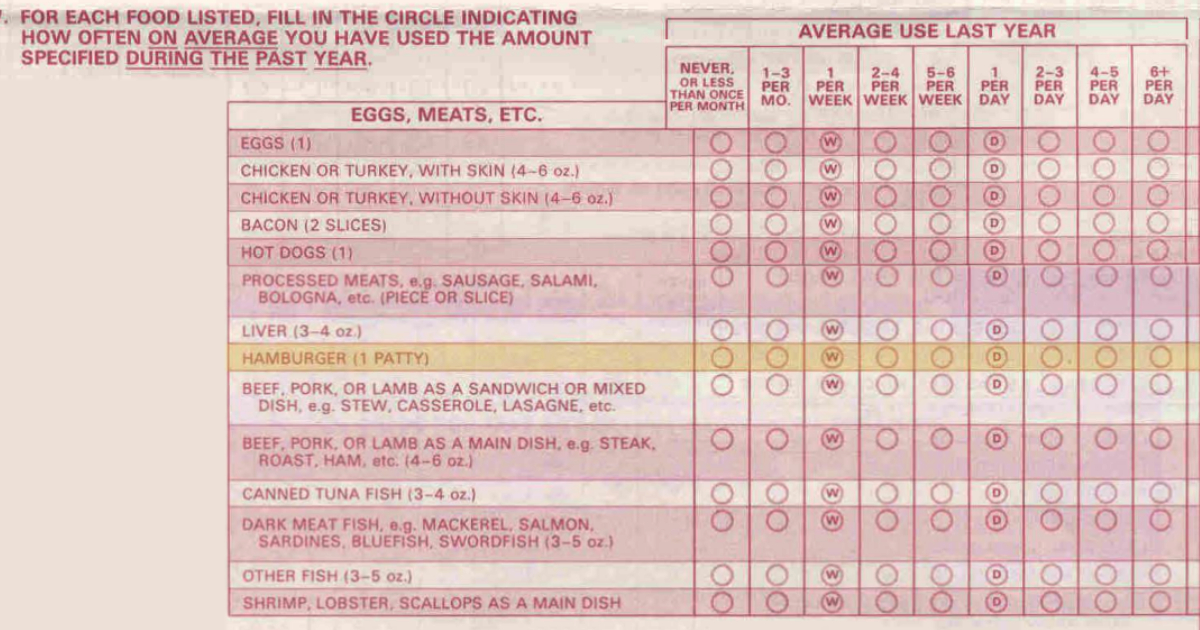
Until very recently, they’ve used the exact same form of the FFQ that was developed 50 years ago. Because we covered studies on meat intake, let’s look at how the FFQ assesses intake of unprocessed meat. I’ll use only one item as an example: Hamburger (1 patty)

FFQ

The problem with this particular choice is that it doesn’t define what makes a patty either by grams or ounces. While I know that things have changed as it relates to our red meat intake, very few of us ever ate more than six hamburgers per day.

Those intake categories across the top apply to every food on the questionnaire. So tell me: how many fresh pears did you eat in 2023? How many tablespoons of jam or jelly? How can anyone answer these questions accurately?

It seems that this questionnaire was made in an era where people had more standardized food intake than they do today, although even back in the 1980s, the concept of family breakfast, lunch, and dinners seemed on its way out. These days we snack and graze, which makes it even harder to remember what we ate.

On Saturday, I’ll wrap this up on why the FFQ may provide a direction but isn’t precise enough to associate diet with disease in my opinion.

What are you prepared to do today?

        Dr. Chet

Reference: https://nurseshealthstudy.org/participants/questionnaires

Is Red Meat Linked to Type 2 Diabetes?

The next study actually precedes the heme iron paper, not only in time but in size—with close to 2 million subjects! This was an attempt to check on whether red meat, chicken, or processed red meat, such as bacon and sausage, are associated with type 2 diabetes. This was a Herculean task that would never be possible without the type of computers available today; just examining the results of the observational studies alone was amazing.

The researchers used a statistical technique called a federated meta-analysis to test the relationship between meat consumption and type 2 diabetes that allows the nutritional data to be analyzed while preserving the anonymity of the subjects. One of the problems was that the data for meat intake had to be standardized among the 31 countries covering the Americas, Eastern Mediterranean, European, South-East Asia, and Western Pacific.

With 1.9 million adults selected for the study, there were just over 107,000 people diagnosed with type 2 diabetes. The median follow-up time was 10 years. The range of meat consumption in all categories was as little as 0 grams up to 110 grams per day. One thing that surprised me as I looked at the medians was that the European processed meat intake far exceeded that of the U.S.—Americans love their hot dogs and cold cuts and sausage and bacon, but apparently not as much as Europeans do.

They found that eating more of each type of meat increased the diagnosis of type 2 diabetes. The Hazard Ratios were:

  • 10% greater risk for each 100 grams of unprocessed red meat
  • 15% greater risk for each 50 grams of processed red meat
  • Only 8% greater risk for every 100 grams of chicken

The increased risk was found in North America, Europe, and the Western Pacific regions. Repeated covariates such as age, gender, or BMI were tested to explain the differences with other regions, but no clear answers emerged. The conclusion? Eating red meat is a risk factor for developing type 2 diabetes across all populations, and processed meat even more so.

Why Meat?

I often criticize these types of studies because they don’t give any reasons or even guesses as to why the results turned out as they did. They couldn’t explain it but gave one possibility that many people don’t consider: red meat and chicken with skin contains fat, and processed red meat has other chemicals used in processing, but what they have in common is protein. If people aren’t eating enough carbohydrates, they are more likely to make glucose from the amino acid remnants of the protein. That’s why people who claim to eat few carbs and starches will end up with prediabetes and fatty livers. I give the authors credit for that.

The real problem, in my opinion, goes back to data collection: almost all studies used a food frequency questionnaire. That’s the topic I’m going to cover next week.

What are you prepared to do today?

        Dr. Chet

Reference:  Lancet Diabetes Endocrinol. 2024; 12: 619–30