Questionable Comments on Dietary Supplements
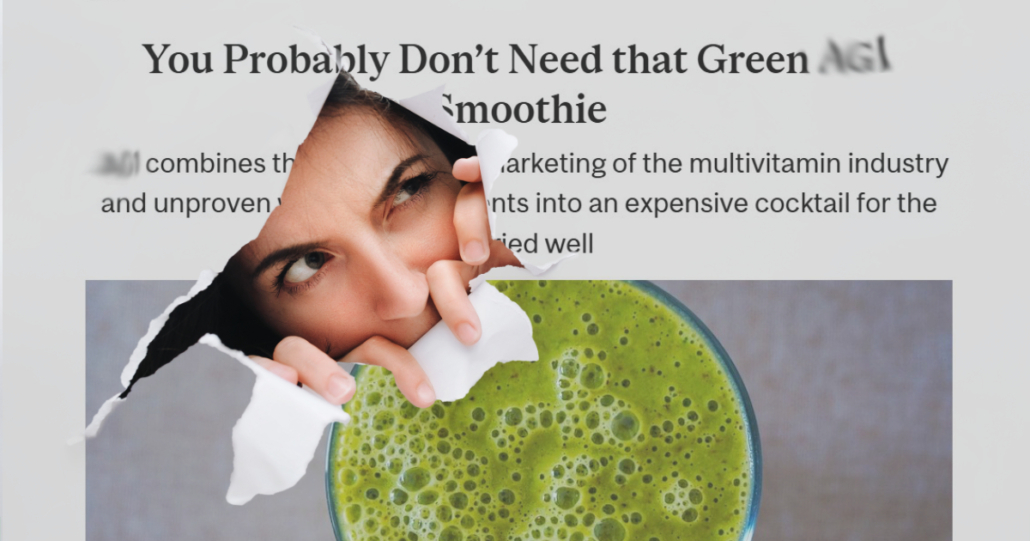
I hope you had a chance to read the article I referred you to on Tuesday; you can still read it by clicking on this link. For the record, I’m not a fan of the AG1 product. In my opinion, supplements should not mix herbals from medicinal plants with vitamins, minerals, and phytochemicals. That aside, there are three main points I alluded to in Tuesday’s Memo so let’s take a look.
Pharmaceuticals vs. Supplements
First, dietary supplements are regulated by the FDA, just not in the same way as pharmaceuticals. Here’s the difference:
- Medicines have to prove they are safe before they are released for use by the public, but they can claim they will prevent, treat, or cure diseases.
- Supplements cannot make such claims; they can make only structure-function claims: “This product may help digestive health,” for instance.
This “fact” as the writer proclaimed is the mantra of the American Medical Association and FDA. It seems worse now that they’re producing videos together for the general public. There’s a lot more arguments here, but that’s for another time.
So Much Beta-Carotene
The author brought up the beta-carotene and smoking studies, but I don’t understand why he didn’t question the amount of beta-carotene used in either study. The studies used four to six times the actual intake of beta-carotene at that time. These made these studies suspect because of the extreme use of beta-carotene in the studies. That’s what should be questioned.
Inadequate Nutrition
The proof was poor that he used to suggest that over 75% of the adult population get adequate vitamins and minerals from the food they eat. It was a study based on data collected via food-frequency questionnaire from specific segments of the Hawaiian and Asian populations in the mid 1990s, and I think we all know that those diets differ from the typical diet on the U.S. mainland or Europe. There are data from the 2021-2023 NHANES study available. It’s difficult to compare the data because of the way they were analyzed in the prior study, but a look at the nutrient intake from food looks more like we get 66% of the RDA, at least for some nutrients such as vitamin A, and worse for other nutrients.
Are there more problems? Yes, but that’s enough. This was a rehash of old arguments to say supplements are not necessary. But there’s one question that no one ever asks in any studies. I’ll leave you in suspense until next week when we look at what one physician said about creatine. I think you’ll be surprised.
What are you prepared to do today?